






































































































































































Chest Workouts Without Equipment: 12 Best Moves to Build Muscle at Home
Author: RVLNSV PRASAD
Updated On: October 2026
About Us
Author Bio
Editorial Policy
Contact Us
Introduction
Chest workouts without equipment can help you build upper-body strength at home without buying dumbbells, weight machines, or a gym membership. With the right exercises and a sensible progression plan, you can challenge your chest muscles using your body weight.
The key is not to perform as many push-ups as possible every day. It is to choose exercises that match your current ability, maintain good technique, and gradually increase the challenge as you become stronger.
You might be able to complete only three wall push-ups at first. That is a perfectly reasonable starting point. As your strength improves, you can progress to incline push-ups, knee push-ups, and eventually standard push-ups if they suit your ability.
Research supports resistance training for improving muscle strength and size. The American College of Sports Medicine’s 2026 evidence review synthesized 137 systematic reviews involving more than 30,000 participants. Its findings support progressive resistance training, with training volume and other variables influencing the results. Read the 2026 ACSM resistance-training evidence review for the detailed findings.
This guide explains 12 practical chest exercises, how to perform them, how to combine them into a beginner-friendly routine, and how to make progress without turning every workout into an exhausting challenge.
Quick Answer: Can You Build Chest Muscle Without Equipment?
Yes. You can develop chest strength and muscle using bodyweight exercises such as push-ups and their easier or harder variations.
Your pectoralis major is the largest chest muscle. It helps move your upper arm across your body and contributes to pushing movements. The pectoralis minor lies underneath it and helps control the shoulder blade.
Bodyweight exercises provide resistance, but the challenge must remain appropriate as you improve. If an exercise becomes too easy, you can adjust its variation, repetitions, range of motion, or tempo.
The CDC’s physical activity guidance recognizes push-ups and other bodyweight movements as muscle-strengthening activities. Adults should generally perform muscle-strengthening activities involving all major muscle groups on at least two days each week.
Key Takeaways
- You do not need a gym to start strengthening your chest.
- Wall, incline, knee, and standard push-ups provide different difficulty levels.
- Slow, controlled repetitions can help you maintain technique, but slowing every movement excessively is not necessary.
- Train your chest with enough effort to create a challenge while leaving room for recovery.
- Increase difficulty gradually instead of adding unlimited repetitions.
- Eat enough nutritious food, including protein, and sleep adequately to support recovery.
- Include pulling and lower-body exercises in your overall routine rather than training only your chest.
Why Chest Training Matters
Your chest muscles contribute to pushing, lifting, and moving your arms across your body. They also work with the shoulders and triceps during many upper-body exercises.
A well-planned chest workout can help you develop strength for activities such as pushing a heavy door, moving household objects, or getting up from the floor. Regular resistance training can also support general physical function.
However, chest exercises do not automatically correct poor posture or prevent every shoulder problem. Your posture and shoulder function depend on several factors, including mobility, strength, daily habits, and the demands of your activities.
The CDC’s overview of muscle-strengthening activity explains how bodyweight movements contribute to physical activity recommendations.
For balanced development, train the chest alongside the back, shoulders, arms, abdomen, and legs. A chest-only routine is not a complete fitness program.
What Makes Bodyweight Chest Training Effective?
Bodyweight training uses your body as resistance. Push-ups are a familiar example, but different variations can make the exercise easier or more challenging.
Three factors matter when you want to build strength and muscle.
1. Appropriate difficulty
An exercise should challenge you without forcing you to sacrifice technique. If standard push-ups are too difficult, raising your hands against a wall or sturdy counter can reduce the challenge.
If standard push-ups become easy, you can consider harder variations or additional repetitions.
2. Progressive overload
Progressive overload means gradually increasing the training challenge over time. You might add a repetition, complete another set, improve your range of motion, or progress to a more demanding variation.
The American College of Sports Medicine’s 2026 evidence review supports progressive resistance training and discusses how training variables affect strength and muscle growth.
You do not need to change everything at once. Make one manageable adjustment, observe how you recover, and then decide whether another increase is appropriate.
3. Consistency and recovery
Muscle adaptation takes time. A few difficult workouts cannot replace a consistent routine maintained over weeks and months.
Recovery matters because your body needs time between demanding sessions. The right frequency depends on your training experience, exercise intensity, and ability to recover.
12 Best Chest Workouts Without Equipment
The following exercises move from beginner-friendly options to more demanding variations. You do not need to perform all 12 during one session.
Choose two or four exercises initially, depending on your ability. Focus on controlled movement before increasing the workload.
1. Wall Push-Up
Best for: Beginners who cannot yet perform floor push-ups comfortably.
Wall push-ups reduce the amount of body weight you need to move. They help you practice the pushing pattern before progressing to a more demanding variation.
How to do it
- Stand facing a wall and place your palms against it at approximately chest height.
- Position your feet slightly behind your hips.
- Bend your elbows and bring your chest toward the wall.
- Keep your body aligned instead of bending only at your waist.
- Push through your palms to return to the starting position.
Starting dose: 2 sets of 8–12 repetitions.
Common mistake: Standing too close to the wall can make the movement unnecessarily easy, while standing too far away may make it difficult to control. Adjust your foot position until the movement feels manageable.
2. Incline Push-Up
Best for: Beginners progressing beyond wall push-ups.
Incline push-ups place your hands on a stable elevated surface. The higher the surface, the easier the movement will generally be compared with a floor push-up.
How to do it
- Place your hands on a sturdy counter or other secure elevated surface.
- Step back until your body forms a reasonably straight line.
- Lower your chest toward the surface by bending your elbows.
- Push back to the starting position without letting your hips sag.
Starting dose: 2 sets of 6–12 repetitions.
Practical tip: Use a surface that cannot slide, tip, or collapse. Avoid unstable chairs or lightweight furniture.
3. Knee Push-Up
Best for: People who are ready for a floor-based variation but cannot yet complete standard push-ups.
Knee push-ups reduce the lever length compared with a standard push-up. They can help you practice the movement while developing upper-body strength.
How to do it
- Begin on your hands and knees.
- Walk your hands forward until your body forms a straight line from your head to your knees.
- Bend your elbows and lower your chest toward the floor.
- Push back up without allowing your lower back to sag.
Starting dose: 2 sets of 6–10 repetitions.
Common mistake: Keeping your hips too far back turns the movement into something closer to a kneeling lean. Move your hands forward enough to create a controlled pushing exercise.
4. Standard Push-Up
Best for: Building general chest and upper-body strength.
The standard push-up is a practical foundation for bodyweight chest training. It works the chest, triceps, and shoulder muscles while requiring your trunk muscles to help maintain body position.
How to do it
- Place your hands on the floor slightly wider than shoulder width.
- Extend your legs behind you and support your body on your hands and toes.
- Keep your head, trunk, and hips aligned.
- Lower your chest by bending your elbows.
- Push the floor away to return to the starting position.
Starting dose: 2–3 sets of 5–12 repetitions, adjusted to your ability.
Form check: Your elbows do not need to point directly sideways. Use a comfortable angle that lets you control the movement.
If you cannot maintain body alignment, switch to an incline or knee push-up instead of forcing additional repetitions.
5. Wide-Grip Push-Up
Best for: Experienced beginners who can already perform standard push-ups.
A wider hand position changes the movement mechanics and may alter how different muscles contribute. However, it does not isolate the outer chest or guarantee a particular chest shape.
How to do it
- Begin in a standard push-up position.
- Move your hands slightly wider than your usual position.
- Lower your body with your elbows moving in a comfortable direction.
- Push back up without bouncing.
Starting dose: 2 sets of 6–10 repetitions.
Common mistake: Placing the hands extremely wide can make the movement uncomfortable for some shoulders. Start with a modest adjustment rather than using the widest position possible.
6. Close-Grip Push-Up
Best for: Developing pushing strength with additional emphasis on the triceps.
Close-grip push-ups use a narrower hand position than standard push-ups. They still involve the chest, but the triceps contribute substantially to the movement.
How to do it
- Start in a push-up position with your hands closer together than usual.
- Keep your wrists in a comfortable position.
- Lower your chest while maintaining control.
- Push back up without allowing your elbows or shoulders to become uncomfortable.
Starting dose: 2 sets of 5–10 repetitions.
You do not have to form a perfect diamond with your hands. A slightly narrower position may be more comfortable for your wrists.
7. Decline Push-Up
Best for: Stronger trainees who want a harder variation.
In a decline push-up, your feet are elevated and your hands remain on the floor. This changes the loading across the upper body and may increase the demand on the shoulders.
It is not automatically superior to a standard push-up for building the chest.
How to do it
- Place your feet on a stable, low platform.
- Position your hands on the floor.
- Keep your body aligned and lower your chest under control.
- Push back up without allowing your hips to sag.
Starting dose: 2 sets of 4–8 repetitions.
Safety note: This is not a starting exercise for most beginners. Skip it if you cannot perform standard push-ups with good control or if the position causes shoulder discomfort.
8. Slow-Lowering Push-Up
Best for: Improving control and making standard push-ups more challenging.
This variation emphasizes the lowering phase, also called the eccentric phase. You do not need to lower extremely slowly; a deliberate three-second descent is a practical starting point.
How to do it
- Begin in a standard push-up position.
- Lower your body over approximately three seconds.
- Pause briefly if you can maintain good control.
- Push up at a comfortable speed.
Starting dose: 2 sets of 5–8 repetitions.
The slower descent increases the time spent controlling the movement. It does not guarantee a specific percentage increase in muscle growth.
9. Pause Push-Up
Best for: Trainees who want to practice control at the bottom of a push-up.
A brief pause removes some of the momentum that may occur when you bounce through a repetition.
How to do it
- Begin in a standard push-up position.
- Lower your body until you reach a comfortable depth.
- Pause for one second without resting your chest on the floor.
- Push back up smoothly.
Starting dose: 2 sets of 5–8 repetitions.
If the pause causes your hips to sag or makes you lose control, return to ordinary push-ups until you are ready.
10. Archer Push-Up
Best for: More advanced trainees developing single-side pushing strength.
Archer push-ups shift more of the workload toward one arm while the opposite arm remains extended farther to the side. This makes the exercise considerably harder than a standard push-up for many people.
How to do it
- Begin in a wide push-up position.
- Shift your body toward one arm as you lower.
- Keep the opposite arm relatively extended without forcing its elbow.
- Push back to the center and repeat on the other side.
Starting dose: 2 sets of 3–5 controlled repetitions per side, only if you already have strong standard push-ups.
Do not rush into this variation. It places a greater demand on the working arm and shoulder, so it is not necessary for beginners.
11. Plyometric Push-Up
Best for: Experienced trainees interested in explosive pushing power.
Plyometric push-ups involve pushing forcefully enough that your hands briefly leave the floor. They require more speed and coordination than ordinary push-ups.
How to do it
- Start in a standard push-up position.
- Lower your body under control.
- Push upward forcefully.
- Land with your hands in a controlled position and absorb the movement.
- Reset if your technique deteriorates.
Starting dose: 2 sets of 3–5 repetitions for appropriately prepared trainees.
This is an advanced exercise, not a requirement for chest muscle growth. Avoid it if you have wrist, elbow, or shoulder discomfort or cannot perform standard push-ups reliably.
12. Scapular Push-Up
Best for: Practicing shoulder-blade control and supporting a balanced upper-body routine.
Scapular push-ups use small movements of the shoulder blades while your elbows remain mostly straight. They are different from standard push-ups because the main movement occurs around the shoulder blades.
How to do it
- Begin in a high-plank position. Use an incline if needed.
- Keep your elbows straight but not forcefully locked.
- Allow your chest to move slightly toward the floor as your shoulder blades come closer together.
- Push the floor away so your shoulder blades move apart.
- Repeat without bending your elbows substantially.
Starting dose: 2 sets of 8–12 repetitions.
This exercise is useful for movement control, but it should not replace the main chest-strengthening exercises. Include it as an optional warm-up or accessory movement.
Comparison Table: Which Chest Exercise Should You Choose?
| Exercise | Difficulty | Main purpose | Suitable starting point |
|---|---|---|---|
| Wall push-up | Easy | Learn the pushing pattern. | Complete beginners |
| Incline push-up | Easy to moderate | Build basic pushing strength. | Beginners |
| Knee push-up | Moderate | Practise floor push-ups. | Developing beginners |
| Standard push-up | Moderate | General chest strength | People with adequate control |
| Wide-grip push-up | Moderate | Vary hand position. | Comfortable standard push-ups |
| Close-grip push-up | Moderate | Chest and triceps strength | Comfortable standard push-ups |
| Decline push-up | Hard | Increase pushing demand. | Strong trainees |
| Slow-lowering push-up | Moderate to hard | Improve controlled loading. | People with good technique |
| Pause push-up. | Moderate to hard | Practice control. | People with good technique |
| Archer push-up | Very hard | Increase unilateral demand. | Advanced trainees |
| Plyometric push-up | Very hard | Explosive pushing power | Experienced trainees |
| Scapular push-up | Easy to moderate | Shoulder-blade control | Most people who tolerate it |
The difficulty labels are general estimates. Your strength, body proportions, technique, and previous training experience can change how challenging each exercise feels.
A Practical Chest Workout at Home Without Equipment
You do not need to perform all 12 exercises in one session. A smaller selection makes it easier to track progress and recover between workouts.
Beginner workout
| Exercise | Sets | Repetitions |
|---|---|---|
| Wall or incline push-up | 2 | 8–12 |
| Knee or standard push-up | 2 | 5–10 |
| Scapular push-up | 2 | 8–12 |
Rest for approximately 60–120 seconds between sets, or longer if you need it to maintain good technique.
Choose either the easier or harder version of each movement according to your ability. You should not need to force the final repetition.
Intermediate workout
| Exercise | Sets | Repetitions |
|---|---|---|
| Standard push-up | 3 | 8–12 |
| Wide-grip or close-grip push-up | 2 | 6–10 |
| Slow-lowering or pause push-up | 2 | 5–8 |
These are starting suggestions, not a mandatory prescription. Reduce the number of sets if your technique deteriorates or you cannot recover comfortably.
The CDC’s muscle-strengthening guidance suggests that one set of 8–12 repetitions can be effective for strengthening, while two or three sets may offer additional benefits. Your appropriate workload depends on your ability and goals.
Weekly Chest Workout Plan for Beginners
For most beginners, two challenging chest sessions per week are a reasonable starting point. Leave recovery time between them and adjust the schedule if you experience persistent soreness or fatigue.
| Day | Activity |
|---|---|
| Monday | Beginner chest workout |
| Tuesday | Walking or comfortable general activity |
| Wednesday | Back, legs, and core training |
| Thursday | Rest or light movement |
| Friday | Repeat the chest workout if recovered. |
| Saturday | General physical activity or mobility |
| Sunday | Rest or gentle activity |
This plan avoids the assumption that your chest needs hard training every day. It also leaves room for other muscle groups.
Adults should aim to strengthen all major muscle groups on at least two days per week, according to the CDC’s adult activity recommendations.
How to Progress When Push-Ups Become Easy
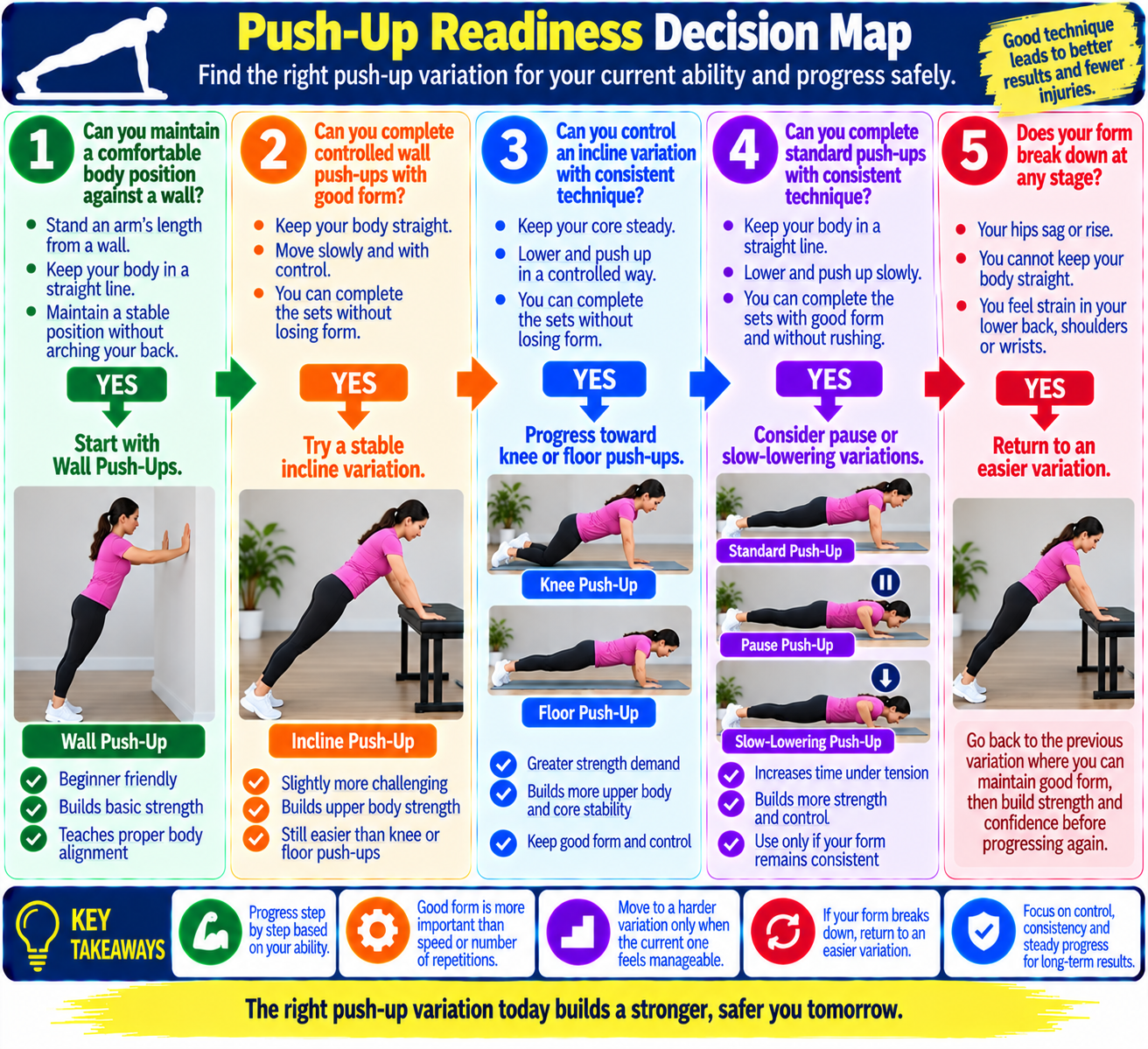
One of the most useful ways to improve a home workout is to decide in advance what progress will look like.
Use this simple progression system:
Step 1: Establish your baseline. Record the variation you use, your sets, and the repetitions you complete with good technique.
Step 2: Build consistency. Repeat the same manageable routine for several sessions instead of changing every exercise each day.
Step 3: Add repetitions gradually. If you complete your target repetitions comfortably, consider adding one repetition to a set during a later session.
Step 4: Increase difficulty when appropriate. Once you can complete the upper end of your target range with control, try a slightly harder variation.
Step 5: Monitor recovery. If performance falls, technique worsens, or soreness interferes with daily activities, reduce the workload or allow more recovery time.
For example, someone who can complete two sets of eight incline push-ups might work toward two sets of twelve before trying a slightly lower, still-stable surface. That is a more measurable approach than switching randomly between difficult exercises.
The 2026 ACSM resistance-training review provides broader evidence about training volume, frequency, and other factors affecting strength and hypertrophy. Its findings do not mean that every person needs the same number of sets or the same routine.
How to Support Chest Muscle Growth With Food and Recovery
Exercise provides the training stimulus, but nutrition and recovery also matter.
Eat enough protein.
Protein supplies amino acids that the body uses to build and repair tissue. Include suitable protein foods across your day rather than relying on a single meal.
Options include eggs, milk, yogurt, paneer, soy foods, lentils, beans, fish, chicken, and other foods that fit your dietary preferences.
A large meta-analysis published in 2017 found that protein supplementation modestly enhanced gains in muscle mass and strength during prolonged resistance training. The study does not mean everyone needs a supplement. Read the systematic review and meta-analysis on protein and resistance training.
Eat enough overall food
If your goal is to gain muscle, consistently eating too little can make the process more difficult. Build meals around a suitable combination of protein foods, vegetables or fruit, whole grains or other carbohydrate sources, and healthy fats.
There is no special herbal drink, detox recipe, or home remedy that directly builds chest muscle. Supplements are not a substitute for a well-designed training routine.
Get adequate sleep.
Sleep supports recovery and general health. Keep a regular sleep schedule where possible, and avoid repeatedly training hard when you are exhausted.
Allow recovery between demanding sessions
Muscle growth does not depend on feeling sore after every workout. You can make progress without severe soreness, and persistent pain should not be treated as evidence that an exercise is working.
A More Useful Way to Measure Progress Beyond the Mirror
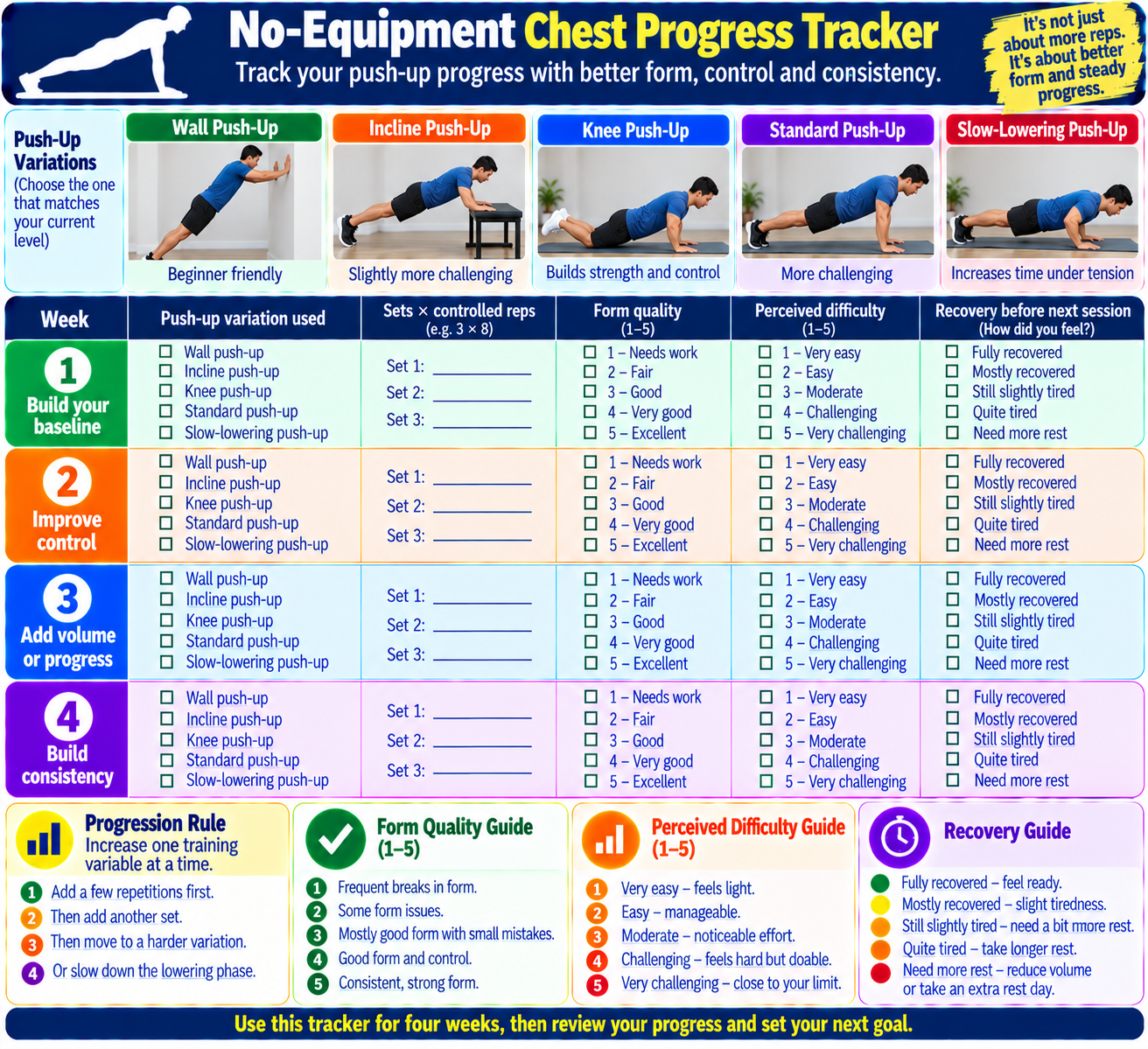
Muscle definition varies with genetics, body-fat levels, lighting, and other individual factors. A mirror alone cannot tell you whether your training is progressing.
Instead, record a few practical measures:
- Which push-up variation you can perform with good form.
- How many controlled repetitions you complete.
- Whether you can maintain body alignment throughout a set.
- How consistently you complete your planned sessions.
- Whether you recover sufficiently before the next workout.
For example, progressing from eight controlled incline push-ups to twelve is measurable improvement even if your chest does not look noticeably different after two weeks.
Take progress photographs only if you find them helpful. They are optional, and day-to-day appearance changes should not determine whether you continue a sensible routine.
Common Mistakes That Can Slow Your Progress
Doing push-ups every day without a plan
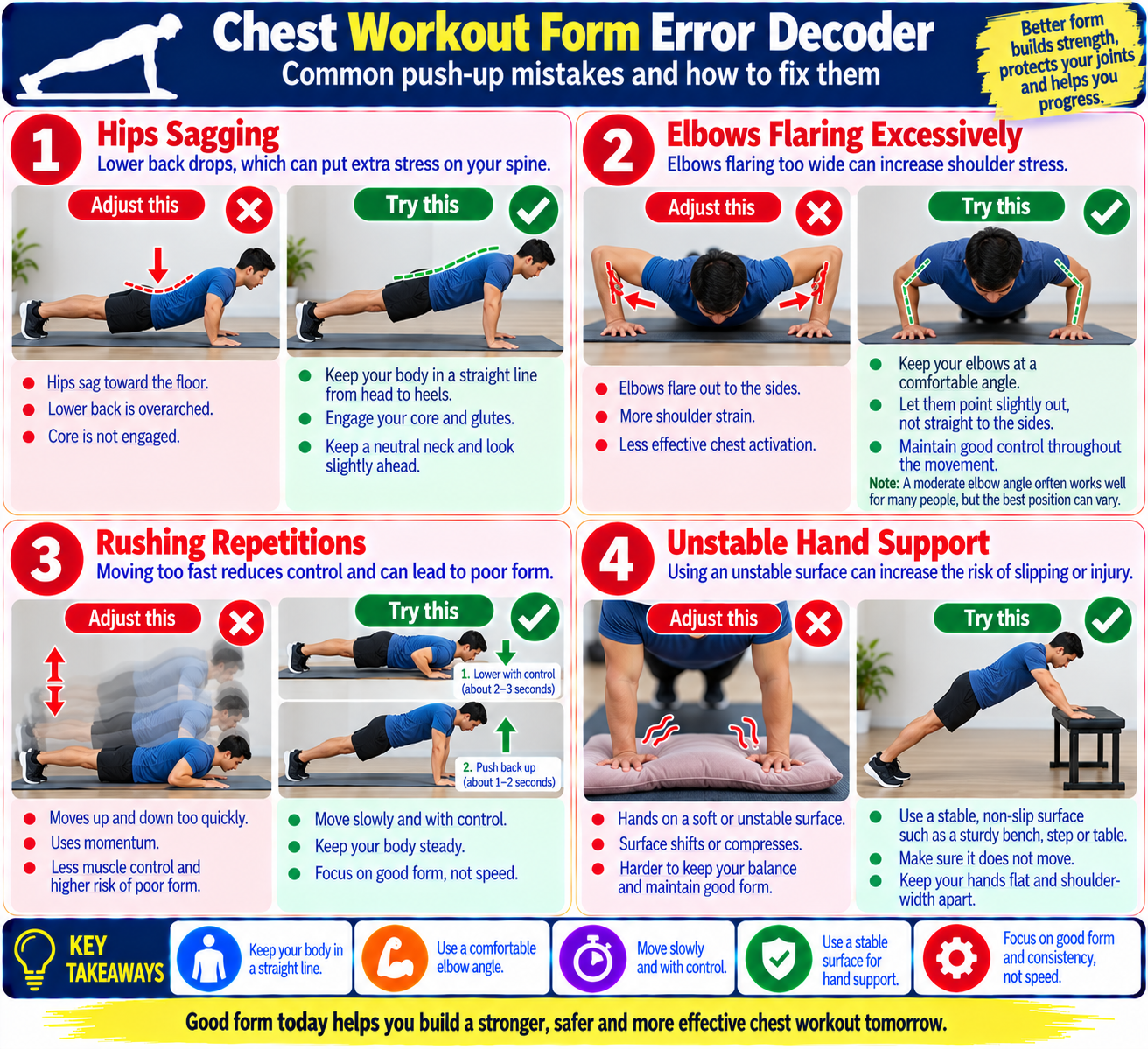
Daily exercise is not automatically a problem, but repeated hard chest sessions can leave some people under-recovered. Begin with a manageable schedule and adjust according to performance and recovery.
Using poor technique to complete more repetitions
Allowing the hips to sag, bouncing through the bottom, or shortening the movement substantially may make repetitions easier to count without maintaining the intended challenge. Stop the set when you can no longer control the movement.
Starting with advanced exercises
Archer and plyometric push-ups are not necessary for beginners. Master a suitable, easier variation before attempting a demanding exercise.
Assuming wider hands build the outer chest
Changing hand position changes the mechanics of the exercise, but it does not guarantee that a particular part of the chest will become more defined. Overall muscle development depends on training, genetics, and other factors.
Ignoring the back and shoulders
A complete program should not consist exclusively of chest exercises. Include pulling movements, leg training, and other forms of strength work to support balanced fitness.
Expecting visible muscle growth in a few days
Strength and exercise control may improve before visible changes become obvious. The timeline for muscle growth varies according to training history, nutrition, genetics, and consistency.
Common Questions About Chest Workouts Without Equipment
1. Can I build a bigger chest without weights?
Yes. Bodyweight push-ups can challenge the chest muscles and contribute to muscle development. You need an appropriate level of difficulty and a way to progress as your strength improves. Eventually, some people may need additional resistance to continue progressing efficiently.
2. How many push-ups should beginners do?
There is no universal number. Start with a variation that lets you perform controlled repetitions. Two sets of approximately 5–12 repetitions can be a practical starting range, depending on the variation and your ability.
3. How many days per week should I train my chest?
Two challenging sessions per week can work well for many beginners. The best schedule depends on your total training volume, experience, and recovery. Train other major muscle groups as part of your overall routine.
4. Which push-up is best for chest growth?
Standard push-ups are a useful starting point for people who can perform them comfortably. Incline and knee push-ups help beginners build capacity, while harder variations can increase the challenge for stronger trainees. No single variation is best for everyone.
5. Can I target the upper chest without equipment?
Decline push-ups change the angle of the exercise and may increase the contribution of the upper chest and shoulders. However, bodyweight variations cannot isolate one region completely, and decline push-ups are not necessary for beginners.
6. How long does it take to see results?
Some people notice better exercise control and strength within several weeks. Visible muscle changes often take longer and vary considerably between individuals. There is no reliable deadline that applies to everyone.
7. Do I need protein supplements?
No. Many people can obtain enough protein from ordinary foods. Supplements may be convenient in some situations, but they are optional and do not replace sufficient overall nutrition and consistent training.
8. Are chest workouts without equipment safe for everyone?
Not necessarily. Choose exercises that match your ability and avoid movements that cause pain. People with existing injuries, recent surgery, or medical conditions that affect exercise should seek individualized guidance from an appropriate healthcare professional.
Conclusion
Chest workouts without equipment offer a practical way to develop upper-body strength at home. Wall push-ups, incline push-ups, knee push-ups, and standard push-ups provide useful starting options, while more advanced variations can increase the challenge as your ability improves.
The most effective routine is not necessarily the longest or hardest one. Choose a manageable selection of exercises, use controlled technique, track your progress, and allow enough recovery between demanding sessions.
Support your training with nutritious meals, adequate protein, sufficient sleep, and exercises for the rest of your body. Be patient with visible changes, because muscle development varies from person to person.
Start with the variation you can perform well today. Build from there, and let consistent progress guide your next step.
Author Note
Author: RVLNSV PRASAD
This article is intended to provide practical, beginner-friendly guidance on bodyweight chest training. The exercise suggestions are general educational information and should be adapted to individual ability, goals, and comfort.
Only add first-person training stories or client examples if they reflect genuine experience. If you have personally tested these exercises, you can add specific observations about which variations were manageable, what adjustments helped, and how you tracked progress. Do not present an invented experience as a verified personal result.
Medical Disclaimer
This article is for general educational purposes and is not a substitute for individualized medical advice, diagnosis, or treatment. Exercise suitability varies by person. Consult a qualified healthcare professional if you have a medical condition, recent surgery, or an injury that may affect your ability to exercise. Stop exercising and seek appropriate medical advice if you experience concerning symptoms such as chest pain, faintness, or unusual shortness of breath.
Fitness Disclaimer
The sets and repetitions in this article are examples, not a personalized training prescription. Adjust them to your current fitness level, use stable surfaces, and prioritize controlled technique. Do not attempt advanced plyometric or archer push-ups before you have the required strength and control.
Evidence and Further Reading
- American College of Sports Medicine — 2026 resistance-training evidence review. An overview of systematic reviews examining resistance-training prescriptions for strength, muscle growth, and physical performance.
- ACSM—announcement of the updated resistance-training position stand. Background on the evidence review and its scope.
- CDC—Adult physical activity guidelines. Official recommendations for aerobic activity and muscle-strengthening exercise.
- CDC—What counts as physical activity for adults?. Explains how push-ups and other bodyweight exercises can count as muscle-strengthening activity.
- Morton and colleagues—Protein supplementation and resistance training, systematic review and meta-analysis. Examines the relationship between protein supplementation and gains in muscle mass and strength during resistance training.
- American College of Sports Medicine — Position stands and scientific communications. A reference point for professional exercise-science guidance.
Similar Content
- Active Living
- 7 Strength Training Exercises for Women Over 40: A Comprehensive Guide
- 5 Simple Home Exercises for Hypothyroidism to Lose Weight
- 6 Home Exercises for Overall Fitness and Flexibility: A Comprehensive Guide
- 8 Easy Breast Lift Exercises
- 10 Best Core Exercises for Beginners at Home: Build a Stronger Core Without Equipment










[…] Chest Workouts Without Equipment: Best 12 Moves to Build Muscle at Home […]
[…] Chest Workouts Without Equipment: Best 12 Moves to Build Muscle at Home […]
[…] Chest Workouts Without Equipment: Best 12 Moves to Build Muscle at Home […]